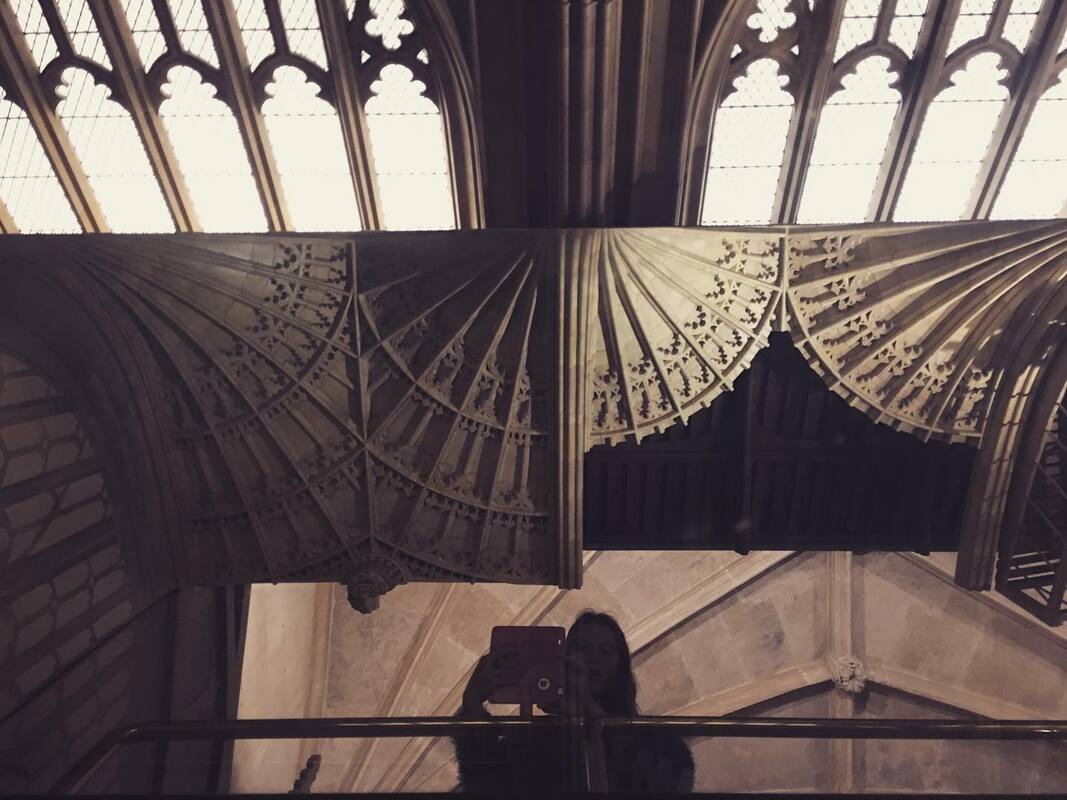
 I like this picture because it is interesting and confusing at the same time: "What is going on here?" Several things seem to be happening at once. They are connected, but how?
I took this picture in the summer of 2019 during a trip to Cambridge, UK. In one of the rooms of King's College Chapel, I found this display explaining architectural features of the building. Somehow, a combination of mirrors and models created this strange and beautiful view, which I decided to capture. My first book finally came out a year after this trip (it had been more than five years in the making). I was happy but not entirely satisfied, since I knew that, to create the linear narrative, I had to leave outside many ideas that seemed important to explore. In fact, I had thought about some of these ideas during my trip to Cambridge, and I even decided that the next book I would write will be about meanings (I distinctly remember that I made this decision as I was inside King's College Chapel). But how would that solve my problem? I knew that to write another coherent book, I would again have to sacrifice many possible directions that my intellectual journey could take. I was interested in so many things at once, and they all seemed to be somehow connected to my main quest - to understand how people can be more connected and less divided. I kept thinking about this dilemma, until one day the following winter, I had a wild idea: I would explore all the topics and ideas simultaneously! That is how my first hypertext project Me, Looking for Meaning began in February 2021. And in November 2021, I launched my second hypertext POWER of meanings // MEANINGS of power on a separate website. Hypertext book is a nonlinear format that requires a digital form and a number of pages/entries connected through links. This format allows me to achieve several goals. I can explore very different ideas and connections between them without worrying (for now) about weaving my investigation into a coherent narrative that unites all these ideas. I can organize thoughts and stories related to my exploration. For this purpose, I create draft entries and use them to keep notes. Once in a while, I choose a draft page and complete it. This way, my creative process is gradual, organic (I write down ideas once I have them, sometimes every day), and open to the reader. When I was writing my print book Media Is Us, nobody could see the evolution of my writing. With hypertexts, readers can see my books in the making. Sometimes I worry that my creative process might appear messy and incomprehensible to visitors of my websites. My commitment to vulnerability allows me to show my raw creative process to strangers, but it's not easy (especially because I am also an editor, and editors are not supposed to be messy with their writing). The picture that I chose to illustrate this page reminds me that complexity can be beautiful, even when it is confusing. I would not be surprised to know that most (if not all) people who land on my websites ask themselves "What is going on here?" I suspect that many may not find a satisfactory answer and leave. But I decided that I will remain true to my creative process; I hope that, if this page has tapped into your curiosity, you will learn something from my intellectual journey.
0 Comments
 "A few weeks ago, I was walking down the street when a small accident about thirty feet away drew my attention. At the traffic light, one car slightly but distinctly 'kissed' the bumper of the vehicle in front of it. An unpleasant interaction between two strangers seemed about to begin. The tailgater looked, indeed, agitated. He smacked his wheel and cursed loudly. A woman got out of the other car and made a few steps towards the vehicle behind her. Passing right by the accident, I shivered slightly, imagining what the woman was about to say.
It was not what I expected..." To read the rest, click here!  Check out my latest essays published outside of this website:
1) Start with Yourself for Courageous RI 2) My Mantra for Dealing with Overwhelming Emotions on Medium 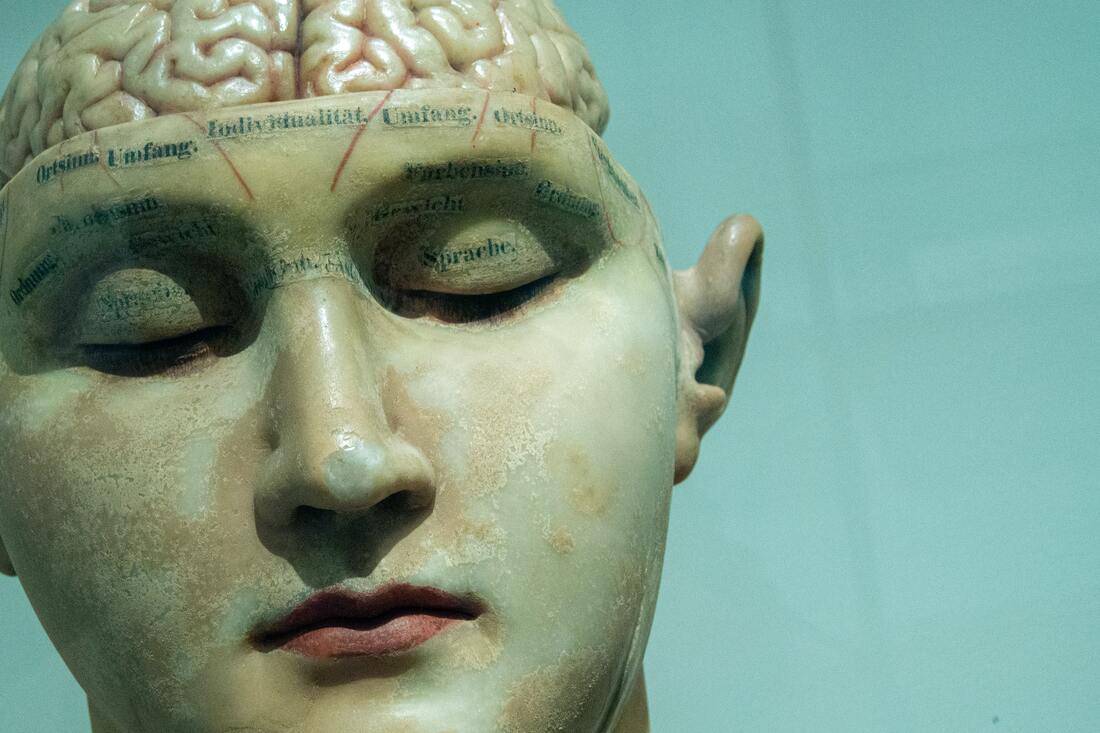 Image credit: David Matos
*Updated entry of my hypertext project POWER of meanings // MEANINGS of power. In some languages, the word power is related to ability (e.g., pouvoir in French and Macht in German). I will take this hint from language and explore what ability has to do with power. Ability is often introduced by the verb "can". As you will see below, this verb may refer to different kinds of power, as in the following statements:
It is important to note the following: power as ability complements power as influence, as these are two aspects of what I call micropower. The concept of micropower is meant to describe what happens on the level of individuals and specific interactions between them (as opposed to what happens at the macro level of society). Indeed, the four statements above describe qualities or situations that should be easy to imagine. It is important to take a close look at power as ability because of how it relates to issues of responsibility and blame. As debates about social problems rage, it is not uncommon for participants to look for a guilty party: somebody who created a problem in question, although they could make different choices; somebody who keeps the problem going, although they could fix it. We should always ask ourselves, "Could they really?" and either give a clear answer or admit that we do not know. Considering power as ability can help us better understand each other and manage our relationships. Here is a personal example: One day when I was still working on this entry, my 4.5-year-old son woke me up at 4:30 am in the morning. He could not go back to sleep and also kept me awake, although I told him that we will only get up at 6 am. I was angry at him until I asked myself: Can he really go to sleep? Can he really lay in bed quietly for 1.5 hours without disturbing me (by tossing, turning and sighing loudly)? Once I realized that the answer to both questions is "no", I was not angry at him anymore, and we had a nice morning together. As I noted in the beginning of this entry, not everything that we call "ability" or introduce using the verb "can" is really a kind of power. It is important to distinguish between levels of the same ability; there is a difference between an ability as a function of our body (basic level) and the same ability used with intentionality (higher level). Intentionality is defined as "the fact of being deliberate or purposive". In other words, it is about making choices with a certain degree of awareness. So, basic level = my body can do (or even simply My body does) = not power; higher level = I can do = power. (The words "basic" and "higher" in this context are not used as an indication of value). Seeing can be described as an ability; somebody who does not see well (and is beyond what glasses could fix) is usually called a person with a disability. Walking can be described as an ability; somebody who does not walk is usually called a person with a disability. However, if we consider seeing and walking on the most basic level, as functions of our bodies, they cannot be described as intentional. For example, if somebody forcefully keeps my eyes open, my eyes will see, no matter if I want to see or not. If I have functioning legs, they will move me around, even if I am just pacing my room. Power comes not just from having an ability as a function of one's body, but from making choices when using this ability. Here is how intentionality is related to responsibility and blame: we cannot blame somebody for a function of their body, but we can hold a person responsible for intentionally using an ability in a certain way. However, the matter is complicated because boundaries between different levels of the same ability are blurry. Yes, I cannot not see if my eyes are open, but I do make choices about what I look at (and I also usually make a choice whether to have my eyes open in the first place). Yes, if my legs are functional I will use them to walk (if not, I will have serious health issues), but I do constantly make choices about where to walk (e.g., to a meeting) or how to walk (e.g., I can decide to walk slowly if I want to be late). To complicate things further, some abilities as functions of our bodies are occasionally called "power". For example, the basic form of seeing is sometimes described as "power of sight", as in the following statement: "The power of sight is often taken for granted, but it greatly affects a person's quality of life". Notice that when we say “power of speech”, we refer to intentionally used ability and not just a body function. At the same time, such phrases as "power of walking" or “power of breathing” (breathing in general rather than in a certain way) sound strange. In the case of “power of sight”, we may be dealing with a quirk of language, a poetic expression rather than a rule (language throwing us off again). Now that I have clarified when an ability is power and when it is not, I will introduce four types of power as ability. As you will see below, this division is artificial, but it is helpful for the purpose of my analysis. The three types of power as ability are "power of body", "power of mind", "mind/body power" and "'may' power". The division between power of body and power of mind is artificial because our mind is a function of the brain, which is a part of the body. Indeed, some abilities are better described as mind/body power. Power of body is mostly restricted to physical strength, hence the example "I can lift a heavy rock." Manifestations of power of body are usually visible, and outcomes can be easily traced to its application (if I see a mental rod before and after it has been bent, I know that somebody bent it). In contrast, manifestations of mind/body power are less visible. In the example "I can calm myself down by slowing down my breath”, we can imagine an observer being able to notice how the breathing of the person making this statement changes (that's the body part of power), although they will not necessarily notice the calming down itself (the mind part of power), since signs of anxiety are not always external. Finally, power of mind happens on a level that is completely hidden from an outside's observer's eyes. Even though direct outcomes of the power of mind can be visible, indirect outcomes are often hidden and difficult to trace back to the application of power. In the example, “I can understand reasons for other people's actions, even if I dislike these actions", the outcome can be me interacting with my adversaries in a certain way without explaining why I am doing that. Perhaps because of its invisibility, power of mind is often misunderstood and valued less than power of body (by the same token, disabilities of the body are more visible and taken seriously than disabilities of mind). However, understanding how power of mind works is essential for making sense of society's flaws and dealing with them. Finally, the last type of power as ability is what I call “may” power. It is exemplified by the statement, “I can tell my boss what I think about her, and she will not fire me”. This power actually exists at the intersection of power as ability and power as influence (suggesting that the division of micropower into ability and influence is also artificial). Notice that the first three types of power as ability can be discussed as unrelated to other people’s abilities and actions. Our actions are, of course, always related to other people, because of the social nature of human beings. What I mean by saying that the first three types of power as ability are unrelated to other people's actions is that we do not have to imagine the role of other people in their existence. I can observe that somebody is physically strong without discussing how this strength may or does affect others, or how this strength is affected by other people. But “may” power us impossible to describe without imagining other individuals and their actions. “May” power is introduced by the verb “can” as in the example above, but “can” here means “be allowed to”, which clearly indicates that a relationship between individuals (rather than properties of one individual) is described here. Considering power as ability allows us to ask questions about sources of our power: Can everybody potentially learn to lift heavy stones? Can everybody potentially learn to slow down their breath in order to calm down? Can everybody learn to understand other people’s actions? Etc. These questions can help us complicate debates about responsibility and blame. 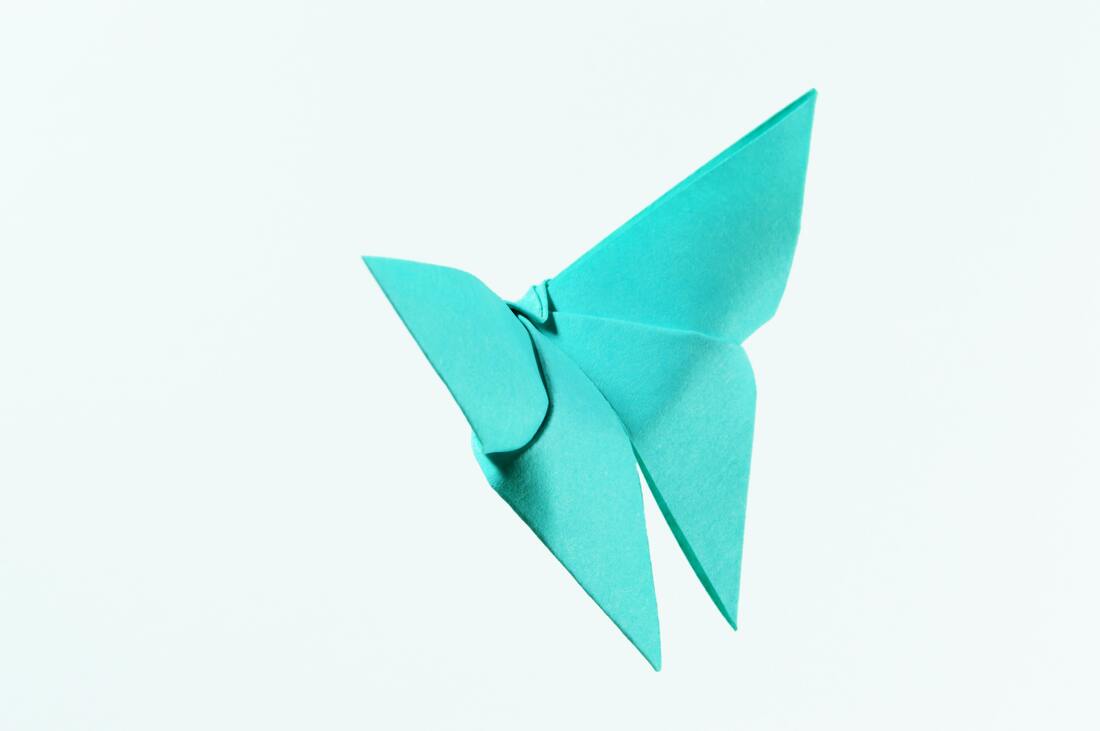 Image credit: Miguel Á. Padriñán
*New entry of my hypertext book POWER of meanings // MEANINGS of power First of all, you may ask, "Who says that power is a thing?", and also "What does it even mean to be or not to be a thing?" In fact, the word "thing" has a slew of definitions. It can refer to an object ("things in my purse"), an abstract concept ("this crazy thing called love"); an affair (from French à faire "to do", as in "I have so many things to do"), a situation ("you should just look at things differently"), an event ("meeting you was the best thing in my life"), an accomplishment ("I want to do great things"), and more. "Thing" is a considerably vague multipurpose word that we use all the time but find incredibly hard to define; so is "power". So, why is power not a thing? I believe that, of all the meanings of the word "thing", the one that best fits the widespread perception of power is this: "an object or entity not precisely designated or capable of being designated". On one hand, power is something vague, so "not precisely designated" fits well. On the other hand, we can say that people usually see power as something related to themselves, but distinct from themselves. Think about such phrases as "have power", "use power", "abuse power", "give power", "take power", "lose power" and "discover power". Therefore, "an object or entity" also seems to describe power well. But appearances are notoriously deceptive. In my book Media Is Us, I explain that we often think about media as something separate from ourselves. I mention that it is not uncommon for people to simplify complex aspects of their own existence (like love) and separate them from their own actions in order to be able to make some sense of them. Unlike media, power is seen as something that we can possess ("have power"), lack, use/abuse, and even share with others ("give power"). While it is not wrong to say that a person can have or lack power (as a combination of abilities and influences), it would be a mistake to limit ourselves with this understanding. A step in the right direction would be to say that the "relationship" between people and power works both ways: individuals have power < > power has individuals. Since the italicized statement sounds like an uncomfortable and confusing paradox – or even like utter nonsense – a useful modification could be, power works through individuals. In fact, this modification echoes the view proposed by Foucault, who argued that power is not simply possessed by (some) individuals. Power cannot be owned or used in the sense that we traditionally accept. Moreover, according to Foucault's enigmatic statement: "Power is everywhere... it comes from everywhere" (Foucault, 1976, p. 93). Even Foucault's view of power, which, in my opinion, brings us significantly closer to understanding this phenomenon, still contributes to the perception of power as a thing. Power remains an "it", even as "it comes from everywhere". This is not a criticism of Foucault, but merely another proof of the fact that language makes it very hard to discuss and make sense of human/social complexity. (As a side note, it is also another proof of the fact that language has power over us.) In fact, my own formulations "power has individuals" and "power works through individuals" are no better in this sense, as they present power as a vague entity that can act upon us. For now, I will have to acknowledge that I do not have a way to talk about power succinctly if I want to explain it as "not a thing". This whole website is one big attempt to define it! But one cannot possibly perceive all the ideas presented in multiple entries of this website at once. In order to explain power the way I feel necessary, I need to take apart many aspects of human condition and coexistence. In the process, I feel forced by language to simplify in order to properly understand. To make sense of the extreme complexity of what we call power, I have to first sacrifice my ability to speak about the complexity that I am trying to understand. It is a very annoying paradox. I can only hope that this sacrifice will eventually pay off. Although I know that defining something through negatives is not ideal, under the circumstances I believe that "power is not a thing" is a good start. It allows us to wonder what being "not a thing" might mean, and this is what my theory of micro- and macropower is meant to clarify. Talking about power is, indeed, a challenge. But this challenge is a good reminder that we cannot let ourselves be too comfortable when trying to get to the bottom of it. Speaking about power as a thing is a simplification that is necessary to even have this exploration. However, we should remember that simplification meant to clarify complex aspects of society often becomes incorporated into meanings of the very "things" that we are trying to understand, contributing to the unhelpful view that these "things" are not so complex after all. SOURCES: Foucault, M. (1976). The History of Sexuality. Vol. 1, The Will to Knowledge, trans. R. Hurley. Penguin, 1998. Merriam-Webster. (n.d.). Thing. https://www.merriam-webster.com/dictionary/thing  *Finally, a new entry from Me, Looking for Meaning!
According to Merriam-Webster, a scholar is "a person who has done advanced study in a special field" and/or "a learned person". I fit in the second sense because of my two doctorate degrees. But when I think about the study (that is, exploration) I have been doing, there is something not unlike impostor syndrome that bothers me. Scholars study, indeed, but do I study things the right way? My first doctoral program back in Russia (2005-2008) introduced me to numerous theories of society, culture, and human nature. Students like me were taught to ask broad questions about the human condition, and I took this approach very seriously. (I still remember having a passionate conversation with a college friend, arguing about "What is culture?" while having a meal in the library cafeteria.) In contrast, my second doctoral program in Philadelphia, US (2011-2015) introduced me to what I saw as proper research: collecting and analyzing data to answer more focused questions about human interactions (e.g., How does a certain subset of the population react to a specific media representation, and what does this reaction suggest about the people or about the representation?). During the second doctoral program, I chose the path of qualitative methods and learned along the way that they are sometimes seen as inferior to quantitative ones, which are supposed to provide better generalizable and more precise information. (Whether quantitative methods are indeed superior is open to debate.) Practicing the research methods I had chosen, I published several academic articles. However, a few years after my graduation I decided to take yet another path, which seemed to lead me even further away from generalizable answers. In the process, I found myself on the path that led right back to the broad philosophical questions that I was so eagerly asking during my graduate studies in Russia. This new shift meant moving away from the kind of data collection and analysis that qualitative scholars of society and human behavior are usually trained to do in English-speaking academia. Today, I do not see my old articles as truly representative of who I am as a scholar. In contrast, the less "formal" works that came later - Media Is Us and my current hypertext projects - reflect my personal approach but do not follow established research rules. Why do I call myself a scholar, then? And why should anybody take my scholarship seriously? My pet peeve about acceptable research in English-speaking academia is that proper scholars are supposed to be specialized, which, to me, means siloed. (I am talking about sciences that explore society, culture, and human nature. I cannot make such statements about "hard" sciences, although I suspect that the situation is the same or very similar there.) Within each discipline, there are multiple very specific sub-disciplines, and even sub-sub-disciplines. If you want to get a job in academia, you are supposed to be very knowledgeable and, ideally, become known in your little corner of the academic universe. I do not mean to disrespect scholars who have chosen this path. The work they do is essential, and I often draw on their findings. However, over time I realized that I don't want to be one of them. The academic siloing makes sense. Scholars have accumulated significant amounts of information about each aspect of society, culture, and human nature (that they consider important enough to explore). The only way to add to this knowledge in meaningful ways, it seems, is to become an expert in a specific chunk of this information. One cannot possibly be an expert on everything that has been written about being human. Either you choose to dig deep into a specific area of knowledge, or you have to admit to being just a surfer, moving across the surface of the collective information pool. So this is who I am: a scholarly surfer. I like to flatter myself thinking that I am somewhat similar to first philosophers, who would not have been able to say: "I interviewed that many people", "I ran an experiment in the lab", or "I read 500 articles on the topic". But they deeply cared about things they were trying to understand. They lived through the questions that they chose to focus on, they looked for answers everywhere, and they kept refining their ideas over the course of their lives. (Lucky dogs, they did not have to worry about how many publications they needed to have in order to get tenure, which freed their mind for other pursuits.) Using everything that I know as the "learned person", I constantly study - meaning, I observe and reflect. According to Merriam-Webster, "study" stands for "a state of contemplation", "application of the mental faculties to the acquisition of knowledge", "careful or extended consideration" and "a careful examination or analysis of a phenomenon, development, or question". These definitions accurately describe the kind of study that I do. As a researcher should, I keep in mind my key questions: Why do people hurt each other? How can we explain and reduce society's flaws without using blame? What could help human beings coexist in ways that would be beneficial for everyone? I have been intently thinking about these questions for years (it took a while just to formulate them!), turning them in my mind, collecting layers of information and examples, writing notes, always striving to understand better. I may not collect and analyze data the "proper way". But I feel incredibly lucky to have access to the giant and fruitful data set known as my life. Writing is an important part of my study process, which I discovered when I started working on Media Is Us, unconstrained by academic limitations. It turns out that I learn a lot by just trying to articulate and write down ideas that are floating in my head. In addition, this scholarly process has always been a kind of therapy for me. Any challenging or confusing life experience becomes a way to learn something new about myself and others. If life gives me lemons, instead of feeling like a victim - ok, ok, I do occasionally enjoy self-pity - I see this as an opportunity to refine answers to my key questions. This approach always helps me regain the feeling of being in control, eventually. If you asked me what kind of scholar I am, I would probably say that I am a philosopher. ("Probably" - because I am well aware that I would not be accepted into the established academic discipline of philosophy.) Starting to work on my hypertext projects allowed me to name my preferred method: rhizomatic research. Basically, my approach is all about finding connections (both likely and not very ones) between many different ideas and things. Here is what I wrote about rhizomatic research on the About page of my hypertext project on power: "Human thinking is non-linear, and power is an especially complex concept. That's why using the non-hierarchical structure for representation and interpretation of ideas about power can be especially fruitful. The hypertext format is ideally suited for this task, as it will allow me to trace connections between multi-layered, multi-branching ideas through links." My scholarship is highly interdisciplinary, which can be seen as both its advantage and its drawback. The advantage of being interdisciplinary is that I can look at things sort of from above. It’s like being on top of a skyscraper and seeing the whole city. It helps me notice useful connections between very different fields of knowledge and practice. The problem with this position is that it is easy to miss details when you are trying to see everything from up high. Moreover, it is simply impossible to see everything. I cannot claim to be the expert in any of the fields I am drawing on. So, I make mistakes. As I am looking at the city from the top of the skyscraper, I may say, "Look, there is a school over there", and then it will turn out to be a store. Or a church. If I was down on the ground next to this building or even in it, I would know for sure, but I would not see in what part of the city it is located, how far it is from, say, a lakeshore (I am imaging myself on the 103rd floor of the Willis Tower in Chicago), and so on. Being interdisciplinary is a trade-off. This is especially true because I am trying to surf across so many different disciplines and practices at once. My comfort zone extends mostly across sciences about society and individuals. However, I do draw on some theories outside of these fields. For example, I find chaos theory relevant for understanding how human beings influence each other in ways that make everybody connected. To further illustrate my interdisciplinary nature, I will finish this page with a quote from my book Media Is Us, the part where I introduce the theory of micro- and macropower. This is an example of how I draw on hard sciences to explain my ideas about society: "We know from physics that rules of the macro world do not apply to quantum mechanics. Atoms might look like little solar systems, but subatomic particles behave nothing like planets. Einstein was actually quite disturbed by the unpredictability of the quantum world, and in his letter to Max Born, he famously stated that God 'does not play dice' (meaning that the same rules should apply to phenomena we see through the microscope and through the telescope). I suggest that, similarly to the universe described by physics, the social world has two different but interconnected planes of existence. I argue that power struggles play out differently based on whether they happen in specific relationships between people (the micro level) or in the universe of all relationships interconnected with each other (the macro level). Oppressors can still oppress and villains do cause harm, but when it comes to society as a whole—which we have such trouble wrapping our individual minds around—additional explanations are necessary" (p. 67).  *This is an updated entry from my hypertext book on power!
The word synesthesia comes from a Greek phrase meaning "to perceive together". Synesthesia can be described as an ability or a condition, but it is not a disease. Depending on the type of synesthesia that a person has, she may "see" music, "taste" sounds or "hear" scents (there are many more variations). I find my synesthesia enjoyable, although specific experiences that it creates are frustratingly difficult to describe. For example, it would be hard for me to tell you what shapes or colors I experience when I eat certain food. Synesthesia is mysterious because the origins of the connections between different sensations are not always obvious. For example, M might be raspberry red for me because raspberry is "malína" in Russian, my mother tongue. But why is A distinctively yellow, and why is B green? Or, moving to a different combination of senses, why does the sound of the saxophone bring up an image of something similar to a silk ribbon or springing, flowing water? I guess it makes some sense, but perhaps it doesn't… My fascination with the word "power" started when I was working on my first book, Media Is Us. In one of the chapters, I proposed a new theory, which has become a basis on the project I am developing here. Since I finished writing that book, I have enjoyed seeing the word "power", writing it, and saying it in my head. It's a kind of a safe obsession, which probably often happens to scholars focusing on a particular topic. It is even more exciting for me now to turn off my computer, because I see the word "power" and its symbol on the screen! (This also gave me the idea for the Power On/Off entry.) As a synesthete, I find the word "power" (in English) intriguing: it is scary and gloomy, but also playful and darkly attractive. It is very difficult to properly describe, but I will try. First, power is a dark word. I see a lot of black, but also some strange glow or flashes of light. "Power" is a paradox: it is soft and springy like a cat playfully hitting with its paw a toy that is bouncing, pow-pow-pow. The game looks like fun, but there is a dangerous glow in the cat's eyes. Any moment, the gentle purring will turn into a subdued but distinctive growl – errrrr – and the toy that was being gently bounced a second ago will be shredded to pieces by the animal's claws. The word "power" is at the same time soft and sharp, calming and dangerous. In this particular case, the origins of my associations seem easier to trace. At least, I can see parallels between them and my developing thoughts about power. It is a dark and scary word because power can and does often cause discomfort, even suffering. We see power as negative when it is used to exploit and subdue. But power can be also seen as something positive, as an ability to help yourself and others. Think about the word "empowerment"! People often think about power as a binary – either it's bad or it's good, either you have it or you don't. I perceive power as a paradox, both intellectually and synesthetically. I want to focus on how we all have and lack power at the same time, because it is not one thing, but rather a combination of abilities and circumstances (see What Is Power?). I also want to explore how "positive" and "negative" aspects of power are intertwined.  For the last two months, I have not completed any new pages in any of my hypertext projects. This feels frustrating at times, because I want to keep writing. But I have not stopped working on my projects. In fact, they are constantly growing in ways that remain invisible for a casual visitor of this site. This hidden efficiency is the beauty of hypertexts, and I am loving the strategy I have discovered.
When I have an interesting thought or come across an example that is connected to one of the topics explored here, I simply add a note to the relevant unfinished page in one of my hypertext projects. This way, each page serves as a repository of ideas on a certain topic. I do not feel stressed thinking that I may forget my thoughts or examples. I am also not worried about having to comb through notes in a Word document, as I used to do in the past. Some of the notes made the old way were never used because I could not remember how they were related to issues that I was discussing! I do write some things down in my iPhone notepad, to be added to relevant hypertext pages later. However, the notepad list is less daunting because it’s not my only way of note-taking. It also feels rewarding when I find some time to go through these bullet points and add them to hypertext entries. My hope is that, as the hypertexts grow (i.e., more pages are added) I will use the iPhone notepad less and less. At this point, I use it mostly when I cannot right away come up with an existing page where the information I want to write down would go. All in all, I feel happy that I am practicing hypertext writing now! It suits my habits very well and allows me to explore many directions of thought in a variety of topics.  Last night, I had a nightmare. I was in a forest with my kids, surrounded by heavy old trunks. And these trunks were falling down, one by one, at random. I never knew when the next one would hit the ground, or where. I was scared. The kids were fine, running around and having fun. But I had to keep my eyes on the trees. It was exhausting. Finally, I called my kids, asking them to take my hands, so that we could leave. At this point, the dream ended abruptly, because my youngest son Sky woke me up.
This dream has an explanation. Over the last two weeks, my anxiety has spiked. When I wake up in the morning and the flood of thoughts comes rushing in, helping me remember what is going on in the world, one of the first words forming in my mind is “shooting”. If you know how much I value empathy and collaboration across political divides, you may wonder how this priority fits with my current fears. I still believe in the importance of a dialogue with people whose views are different from mine. Not everybody would listen, but chances for having a conversation may increase if we use Nonviolent Communication. Trying to have a dialogue does not mean that we should not take action: to be heard, to change things, to protect the ones we love the most. This is why I am going to March for Our Lives on June 11 in Chicago. If you are interested in going, you should be able to find an event near you using the link above. Donating to the movement and going to the march are my ways to do something. Creating this blog and sharing thoughts with friends is another action I can take. Using my writing to figure out how people with differing views can coexist peacefully is my ongoing, albeit the least direct, contribution to the cause that I am so passionate about. Perhaps, you can find your own way to take part in this effort. Each one of us has more power than we notice. If we learn to use this power, together we can create a change, not through blame and hatred, but through love. This is what I believe. I do not want to be afraid of the trees. *I have three hypertext projects going on at this point, and I felt that they needed an intro page. The result is below! I like this picture, because it is interesting and confusing at the same time. I hope that readers will find my hypertext projects equally intriguing as they ask themselves: "What is going on here?".
Hypertext book is a nonlinear format that requires a digital form and a number of pages/entries connected through links. After publishing a print book, I realized that there are just too many ideas and directions to explore. So, I decided to explore them all simultaneously! Once in a while, I complete a page. But most of the time (when I have time to write), I organize my ideas in existing draft entries, of which I currently have dozens and may have hundreds in the future. (The only one of the three projects without draft entries is It's Not about "Them" on Medium, where I decided to try a different approach.) Let's be honest, the result will surely look messy to an outside observer. My commitment to vulnerability allows me to show my raw creative process to strangers, but it's not easy (especially because I am also a freelance editor, and editors are not supposed to be messy with their writing). So, what are the three projects I am talking about? One focuses on issues of meaning, the other one is about power, while the last book that I started is dedicated to polarization. In my mind, these three topics are interconnected. However, I found that it's useful to separate them in order not to smash everything together (said the person who decided to explore all of her ideas at once). But, seriously, there is order and there is logic in my explorations - only I find a traditional linear format too restrictive for my intellectual journey. The hypertext format helps me keep track of my ideas, to continue writing even when I have little time for creativity, and to collect materials for future print books. I do want to convert my work into linear texts eventually. In the meantime, I will let my hypertexts grow in the most perfectly imperfect way possible. As for the picture above, I will tell you what it is! Back in the summer 2019 (oh, sweet pre-Covid times), I travelled to the United Kingdom with my family. There, we visited Cambridge (we actually lived there for a couple of weeks). The picture shows one of the old cathedrals. It had an area with huge mirrors that reflected the ceiling so that visitors could see it better. (I am thinking now that they may have been showing a model of the ceiling, which adds another layer of confusion to the image.) You can see me bending over the railing in order to take a picture of the reflection (of the model?) and the surrounding walls. It's still hard to make sense of what is going on, but it was surely beautiful to observe. In a similar way, my hypertext books are about capturing the beauty, complexity and confusion when it comes to the big questions of human coexistence. |