How Humans Live by Ideas
*last updated on January 7, 2026
My son Robin (then age five) was watching an ant climb a chair when he asked, “Do ants think that chairs are buildings?” I said, “No. To think that a chair is a building, an ant would need an idea of ‘building.’” That conversation started me thinking.
Ants can learn and adapt in impressive ways, but the best evidence suggests that their behavior is usually guided by local sensory cues, learned associations, and evolved routines—not by the kind of flexible, language-like categorization humans use when we decide what “counts as” a building. Robin’s question, however, was already conceptual. It asked about what counts as a building, what it would mean to represent one thing as another, and what kind of mind could do that.
This is a common claim about humans: we do not only respond to what we perceive; we also represent the world through general ideas. We can think about “building” even when no building is present, and we can apply that idea to new situations. We can also create and contest ideals—justice, rights, freedom, equality—that are not objects in the world but frameworks for evaluating it. The question is what kind of reality these ideas have. Are they merely convenient labels, or do they refer to something more stable than individual experience?
Plato’s theory of Forms is a classic attempt to answer this. In many of his middle-period dialogues, Plato treats universals—such as Beauty or Justice—as real in a strong sense: not just words or thoughts, but objects of understanding that are more stable than the changing world of particular things. Particular things are what they are, on this view, because they “participate in” or resemble a Form. Physical chairs are varied and imperfect; “Chair-ness,” as a universal, is stable and intelligible. Plato’s argument is not simply that we can generalize, but that the very possibility of stable knowledge points beyond the shifting material world to something constant.
Later thinkers challenged this sharp separation between a realm of Forms and the physical world. Aristotle’s response is often described as immanent: form is not in a separate realm but is found in things themselves, and the mind comes to grasp general features by learning from and abstracting out of particulars. Early modern empiricists pushed further: ideas originate in sensory experience, and general concepts are built from repeated encounters, comparison, and mental association rather than from access to a metaphysically separate reality. Locke is a standard example of this approach, arguing that the “materials” of knowledge come from experience. Kant complicated the debate by arguing that the mind contributes basic structures that make experience intelligible in the first place; some of what looks like “the world” is shaped by the forms and categories through which we experience it. In more recent philosophy—especially in pragmatic and ordinary-language traditions—meaning is often treated as grounded in use: what an idea “is” cannot be separated from how a community applies it in practice.
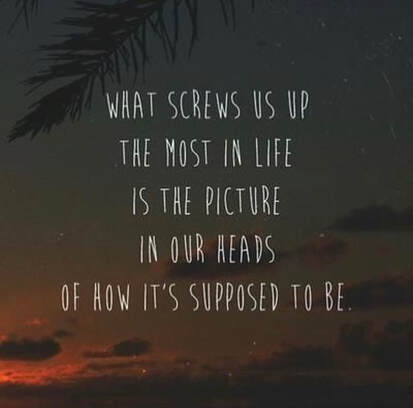
These disagreements matter because ideas do not stay neutral. We often live by a “picture in our heads” of how life is supposed to be, and that picture can produce distress when reality diverges from it. The problem is not only disappointment but a sense of error: if reality does not match the picture, we may conclude that something is wrong with the world, with other people, or with ourselves. This can happen in everyday life—relationships, parenting, work—and it can happen at the level of public values.
Consider ideals such as rights, freedom, and equality. They sound universal, but they are underdetermined until they are specified. People may sincerely endorse the same ideal while holding incompatible interpretations of what it requires in a concrete dispute. This is a common source of misunderstanding and conflict: disagreement is framed as moral failure (“How can you be against freedom?”) when it is often a dispute over definitions, priorities, and trade-offs.
A plausible evolutionary perspective helps explain why humans rely on ideas so heavily. Concepts allow compression and transfer of knowledge: instead of treating every new situation as unique, we categorize it and apply what we have learned before. Ideas also support planning across time and coordination with others, including non-kin. Shared concepts, norms, and narratives make large-scale cooperation possible. In that sense, abstraction is not an ornamental capacity; it is part of what enables human societies.
The same capacity creates predictable problems. Concepts can harden into reified entities: we treat an abstract model as if it were a concrete fact, and we become less willing to revise it. Ideals can become identity markers rather than tools for inquiry, so disagreement feels like a threat rather than a reasoned difference. Abstract language can also facilitate rationalization: it can conceal harm under respectable terms and turn complex situations into simplified moral stories.
Robin’s question about ants and chairs is small, but it points to this larger structure. Humans build conceptual worlds and then inhabit them. That is a source of knowledge, cooperation, and moral aspiration, but it also creates conflict and suffering when the internal picture becomes rigid. The task is not to abandon ideas—there is no human life without them—but to treat them as fallible representations that require interpretation, context, and revision.
About this project: Start page
Ants can learn and adapt in impressive ways, but the best evidence suggests that their behavior is usually guided by local sensory cues, learned associations, and evolved routines—not by the kind of flexible, language-like categorization humans use when we decide what “counts as” a building. Robin’s question, however, was already conceptual. It asked about what counts as a building, what it would mean to represent one thing as another, and what kind of mind could do that.
This is a common claim about humans: we do not only respond to what we perceive; we also represent the world through general ideas. We can think about “building” even when no building is present, and we can apply that idea to new situations. We can also create and contest ideals—justice, rights, freedom, equality—that are not objects in the world but frameworks for evaluating it. The question is what kind of reality these ideas have. Are they merely convenient labels, or do they refer to something more stable than individual experience?
Plato’s theory of Forms is a classic attempt to answer this. In many of his middle-period dialogues, Plato treats universals—such as Beauty or Justice—as real in a strong sense: not just words or thoughts, but objects of understanding that are more stable than the changing world of particular things. Particular things are what they are, on this view, because they “participate in” or resemble a Form. Physical chairs are varied and imperfect; “Chair-ness,” as a universal, is stable and intelligible. Plato’s argument is not simply that we can generalize, but that the very possibility of stable knowledge points beyond the shifting material world to something constant.
Later thinkers challenged this sharp separation between a realm of Forms and the physical world. Aristotle’s response is often described as immanent: form is not in a separate realm but is found in things themselves, and the mind comes to grasp general features by learning from and abstracting out of particulars. Early modern empiricists pushed further: ideas originate in sensory experience, and general concepts are built from repeated encounters, comparison, and mental association rather than from access to a metaphysically separate reality. Locke is a standard example of this approach, arguing that the “materials” of knowledge come from experience. Kant complicated the debate by arguing that the mind contributes basic structures that make experience intelligible in the first place; some of what looks like “the world” is shaped by the forms and categories through which we experience it. In more recent philosophy—especially in pragmatic and ordinary-language traditions—meaning is often treated as grounded in use: what an idea “is” cannot be separated from how a community applies it in practice.
These disagreements matter because ideas do not stay neutral. We often live by a “picture in our heads” of how life is supposed to be, and that picture can produce distress when reality diverges from it. The problem is not only disappointment but a sense of error: if reality does not match the picture, we may conclude that something is wrong with the world, with other people, or with ourselves. This can happen in everyday life—relationships, parenting, work—and it can happen at the level of public values.
Consider ideals such as rights, freedom, and equality. They sound universal, but they are underdetermined until they are specified. People may sincerely endorse the same ideal while holding incompatible interpretations of what it requires in a concrete dispute. This is a common source of misunderstanding and conflict: disagreement is framed as moral failure (“How can you be against freedom?”) when it is often a dispute over definitions, priorities, and trade-offs.
A plausible evolutionary perspective helps explain why humans rely on ideas so heavily. Concepts allow compression and transfer of knowledge: instead of treating every new situation as unique, we categorize it and apply what we have learned before. Ideas also support planning across time and coordination with others, including non-kin. Shared concepts, norms, and narratives make large-scale cooperation possible. In that sense, abstraction is not an ornamental capacity; it is part of what enables human societies.
The same capacity creates predictable problems. Concepts can harden into reified entities: we treat an abstract model as if it were a concrete fact, and we become less willing to revise it. Ideals can become identity markers rather than tools for inquiry, so disagreement feels like a threat rather than a reasoned difference. Abstract language can also facilitate rationalization: it can conceal harm under respectable terms and turn complex situations into simplified moral stories.
Robin’s question about ants and chairs is small, but it points to this larger structure. Humans build conceptual worlds and then inhabit them. That is a source of knowledge, cooperation, and moral aspiration, but it also creates conflict and suffering when the internal picture becomes rigid. The task is not to abandon ideas—there is no human life without them—but to treat them as fallible representations that require interpretation, context, and revision.
About this project: Start page