Elizaveta Friesem
  • About
  • Books
    • Media is us >
      • Principles of communication
      • Micro- and macropower
      • ACE model
      • Description of chapters
    • Hypertexts >
      • Me, looking for meaning >
        • A >
          • Are you an individual?
        • B
        • C
        • D
        • E >
          • Empathy with Boundaries
        • F
        • G
        • H >
          • Human thinking
          • Human thinking is nonlinear
        • I >
          • Ideas
        • J
        • K
        • L >
          • List of completed pages
          • The Lure of Special
        • M >
          • Make Sense
          • Mean and stupid
          • Meaning
          • Meaningless
          • Meaning-making vs. sensemaking
          • My quest for meaning
          • The Myth of "Bad People"
        • N >
          • Narratives and Circumstances
        • O >
          • On being a scholar
        • P >
          • Postmodern philosophy
        • Q
        • R >
          • Reality
          • Rethinking What It Means to “Love Your Enemy”
          • Rhizome in philosophy
        • S >
          • Stories we tell
          • Symbolic interactionism and Buddhism
        • T >
          • The importance of having a purpose
          • Three Blind Men vs Rashomon
          • Three Coordinates
          • Trust and Conflict (and Dragons)
        • U
        • V
        • W >
          • What does it mean to "understand"?
          • What's the point?
          • Why do people hurt each other?
          • Why is language so unhelpful?
          • Moral complexity and ambiguity of truth in Wicked
        • X
        • Y
        • Z
  • Editing
    • Me as your editor
    • How I will help you
    • Pricing
    • Privacy policy
  • Blog
  • Poetry
    • Video poems (English and Russian) >
      • Butterfly (poem)
      • One day, I will return (poem)
      • Where are you now? (poem)
      • Hole in the world (poem)
      • Wondering (poem)
      • Wanderer II (poem)
      • What people call love (poem)
      • Lullaby (poem)
      • You Walk Along These Streets (Poem in Russian)
    • Russian poems >
      • Stranger
      • Lonely heart
      • Fairy tales
      • Dreams and nightmares
      • Puzzles
      • Moon
      • Seasons
      • Muse
      • Art
      • Games
      • Sketches
      • Nonsense
  • Learn more
    • Bio
    • Talks and interviews
    • Essays
    • Epoxy resin
    • Photography
    • Workshops >
      • Five (easy) steps to become media literate
      • Surviving the polarization vortex
      • Understanding yourself
      • Not enough
  • Contact me

Five Fundamental Principles of Communication

Picture
We often think that the modern media is fundamentally different from anything that came before it. It's true that Egyptian pharaohs did not carry smartphones in their pockets, and did not leave messages on Facebook walls. They did leave messages on other walls, though...

The pharaohs, their contemporaries around the globe, and our ancestors for many generations before them exchanged ideas in numerous ways. Their communication practices were dramatically different from our interactions today. Yet, all of us also have a lot in common. 

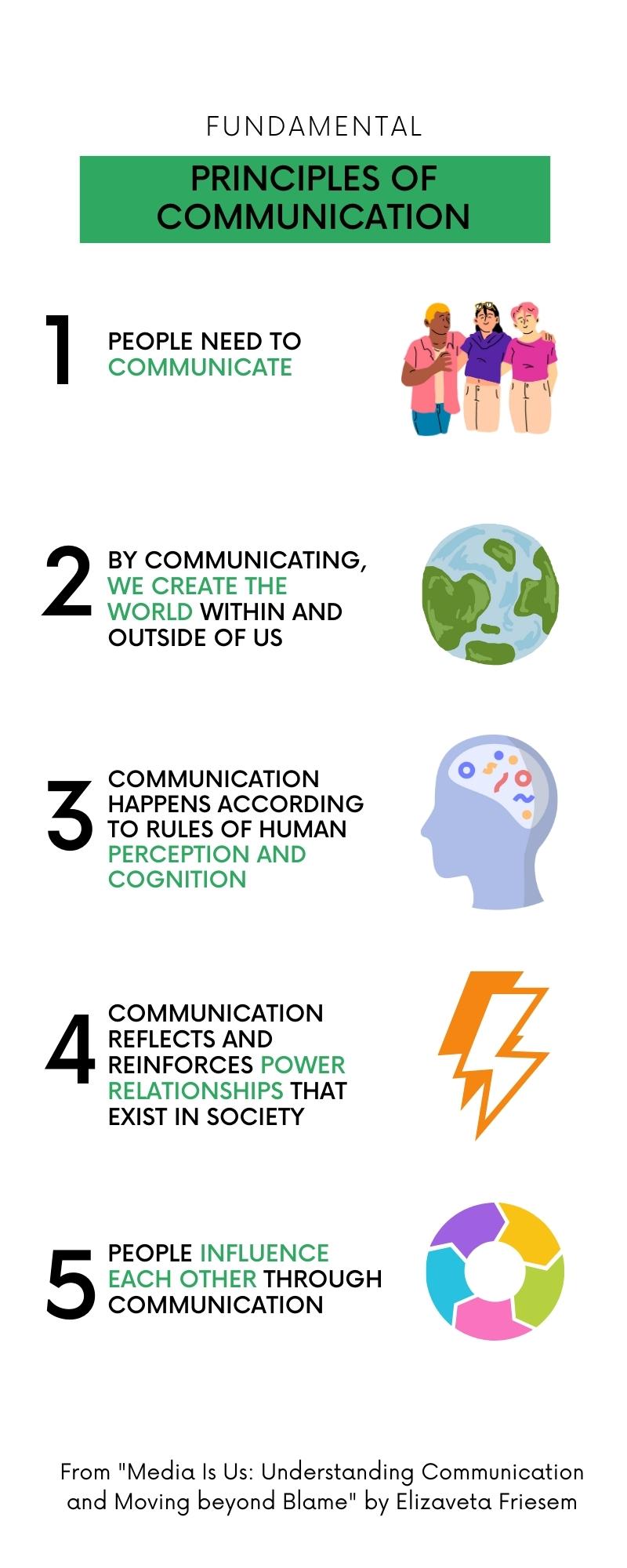
Media can be described as people communicating with each other through technology. But what is "technology" exactly? Broadly defining this term will lead us to broaden our understanding of media as well. Without discounting the uniqueness of modern communication forms (big data, algorithms, world wide web and so on), we may need to acknowledge that some things have not changed. In my book, I propose five fundamental principles of communication that describe human interactions both of the past and of today, when the latest technologies can fit into our pockets:

​#1 – People need to communicate

#2 – By communicating, we create the world within and outside of us

#3 – Communication happens according to rules of human perception and cognition

#4 – Communication reflects and reinforces power relationships that exist in society
​
#5 – People influence each other through communication

Culture is always changing. There are similarities between the walls of the great pyramids and Facebook walls, but ignoring their differences would be naïve and misleading. Exploring new cultural forms in the context of the fundamental principles listed above may be the best strategy for understanding both.

To find out more about the Principles of Communication, read my blog on Goodreads.

YOU CAN DOWNLOAD THE INFOGRAPHIC BELOW
Picture

I use AI tools as a kind of writing partner—to shape drafts, clarify arguments, and explore phrasing. But the ideas, perspectives, and direction are always my own. Every piece here is part of an evolving personal project. For more details about my use of AI, see here.
  • About
  • Books
    • Media is us >
      • Principles of communication
      • Micro- and macropower
      • ACE model
      • Description of chapters
    • Hypertexts >
      • Me, looking for meaning >
        • A >
          • Are you an individual?
        • B
        • C
        • D
        • E >
          • Empathy with Boundaries
        • F
        • G
        • H >
          • Human thinking
          • Human thinking is nonlinear
        • I >
          • Ideas
        • J
        • K
        • L >
          • List of completed pages
          • The Lure of Special
        • M >
          • Make Sense
          • Mean and stupid
          • Meaning
          • Meaningless
          • Meaning-making vs. sensemaking
          • My quest for meaning
          • The Myth of "Bad People"
        • N >
          • Narratives and Circumstances
        • O >
          • On being a scholar
        • P >
          • Postmodern philosophy
        • Q
        • R >
          • Reality
          • Rethinking What It Means to “Love Your Enemy”
          • Rhizome in philosophy
        • S >
          • Stories we tell
          • Symbolic interactionism and Buddhism
        • T >
          • The importance of having a purpose
          • Three Blind Men vs Rashomon
          • Three Coordinates
          • Trust and Conflict (and Dragons)
        • U
        • V
        • W >
          • What does it mean to "understand"?
          • What's the point?
          • Why do people hurt each other?
          • Why is language so unhelpful?
          • Moral complexity and ambiguity of truth in Wicked
        • X
        • Y
        • Z
  • Editing
    • Me as your editor
    • How I will help you
    • Pricing
    • Privacy policy
  • Blog
  • Poetry
    • Video poems (English and Russian) >
      • Butterfly (poem)
      • One day, I will return (poem)
      • Where are you now? (poem)
      • Hole in the world (poem)
      • Wondering (poem)
      • Wanderer II (poem)
      • What people call love (poem)
      • Lullaby (poem)
      • You Walk Along These Streets (Poem in Russian)
    • Russian poems >
      • Stranger
      • Lonely heart
      • Fairy tales
      • Dreams and nightmares
      • Puzzles
      • Moon
      • Seasons
      • Muse
      • Art
      • Games
      • Sketches
      • Nonsense
  • Learn more
    • Bio
    • Talks and interviews
    • Essays
    • Epoxy resin
    • Photography
    • Workshops >
      • Five (easy) steps to become media literate
      • Surviving the polarization vortex
      • Understanding yourself
      • Not enough
  • Contact me