MY HYPERTEXT PROJECTS
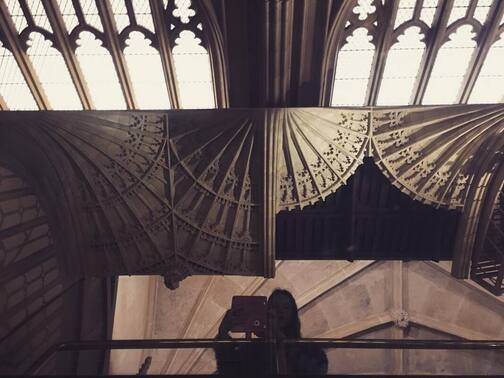
I like this picture because it is interesting and confusing at the same time: "What is going on here?" Several things seem to be happening at once. They are connected, but how?
I took this picture in the summer of 2019 during a trip to Cambridge, UK. In one of the rooms of King's College Chapel, I found this display explaining architectural features of the building. Somehow, a combination of mirrors and models created this strange and beautiful view, which I decided to capture.
My first book finally came out a year after this trip (it had been more than five years in the making). I was happy but not entirely satisfied, since I knew that, to create the linear narrative, I had to leave outside many ideas that seemed important to explore. In fact, I had thought about some of these ideas during my trip to Cambridge, and I even decided that the next book I would write will be about meanings (I distinctly remember that I made this decision as I was inside King's College Chapel).
But how would that solve my problem? I knew that to write another coherent book, I would again have to sacrifice many possible directions that my intellectual journey could take. I was interested in so many things at once, and they all seemed to be somehow connected to my main quest - to understand how people can be more connected and less divided. I kept thinking about this dilemma, until one day the following winter, I had a wild idea: I would explore all the topics and ideas simultaneously! That is how my first hypertext project Me, Looking for Meaning began in February 2021. And in November 2021, I launched my second hypertext POWER of meanings // MEANINGS of power on a separate website.
Hypertext book is a nonlinear format that requires a digital form and a number of pages/entries connected through links. This format allows me to achieve several goals. I can explore very different ideas and connections between them without worrying (for now) about weaving my investigation into a coherent narrative that unites all these ideas. I can organize thoughts and stories related to my exploration. For this purpose, I create draft entries and use them to keep notes. Once in a while, I choose a draft page and complete it. This way, my creative process is gradual, organic (I write down ideas once I have them, sometimes every day), and open to the reader.
When I was writing my print book Media Is Us, nobody could see the evolution of my writing. With hypertexts, readers can see my books in the making. Sometimes I worry that my creative process might appear messy and incomprehensible to visitors of my websites. My commitment to vulnerability allows me to show my raw creative process to strangers, but it's not easy (especially because I am also an editor, and editors are not supposed to be messy with their writing).
The picture that I chose to illustrate this page reminds me that complexity can be beautiful, even when it is confusing. I would not be surprised to know that most (if not all) people who land on my websites ask themselves "What is going on here?" I suspect that many may not find a satisfactory answer and leave. But I decided that I will remain true to my creative process; I hope that, if this page has tapped into your curiosity, you will learn something from my intellectual journey.
I took this picture in the summer of 2019 during a trip to Cambridge, UK. In one of the rooms of King's College Chapel, I found this display explaining architectural features of the building. Somehow, a combination of mirrors and models created this strange and beautiful view, which I decided to capture.
My first book finally came out a year after this trip (it had been more than five years in the making). I was happy but not entirely satisfied, since I knew that, to create the linear narrative, I had to leave outside many ideas that seemed important to explore. In fact, I had thought about some of these ideas during my trip to Cambridge, and I even decided that the next book I would write will be about meanings (I distinctly remember that I made this decision as I was inside King's College Chapel).
But how would that solve my problem? I knew that to write another coherent book, I would again have to sacrifice many possible directions that my intellectual journey could take. I was interested in so many things at once, and they all seemed to be somehow connected to my main quest - to understand how people can be more connected and less divided. I kept thinking about this dilemma, until one day the following winter, I had a wild idea: I would explore all the topics and ideas simultaneously! That is how my first hypertext project Me, Looking for Meaning began in February 2021. And in November 2021, I launched my second hypertext POWER of meanings // MEANINGS of power on a separate website.
Hypertext book is a nonlinear format that requires a digital form and a number of pages/entries connected through links. This format allows me to achieve several goals. I can explore very different ideas and connections between them without worrying (for now) about weaving my investigation into a coherent narrative that unites all these ideas. I can organize thoughts and stories related to my exploration. For this purpose, I create draft entries and use them to keep notes. Once in a while, I choose a draft page and complete it. This way, my creative process is gradual, organic (I write down ideas once I have them, sometimes every day), and open to the reader.
When I was writing my print book Media Is Us, nobody could see the evolution of my writing. With hypertexts, readers can see my books in the making. Sometimes I worry that my creative process might appear messy and incomprehensible to visitors of my websites. My commitment to vulnerability allows me to show my raw creative process to strangers, but it's not easy (especially because I am also an editor, and editors are not supposed to be messy with their writing).
The picture that I chose to illustrate this page reminds me that complexity can be beautiful, even when it is confusing. I would not be surprised to know that most (if not all) people who land on my websites ask themselves "What is going on here?" I suspect that many may not find a satisfactory answer and leave. But I decided that I will remain true to my creative process; I hope that, if this page has tapped into your curiosity, you will learn something from my intellectual journey.